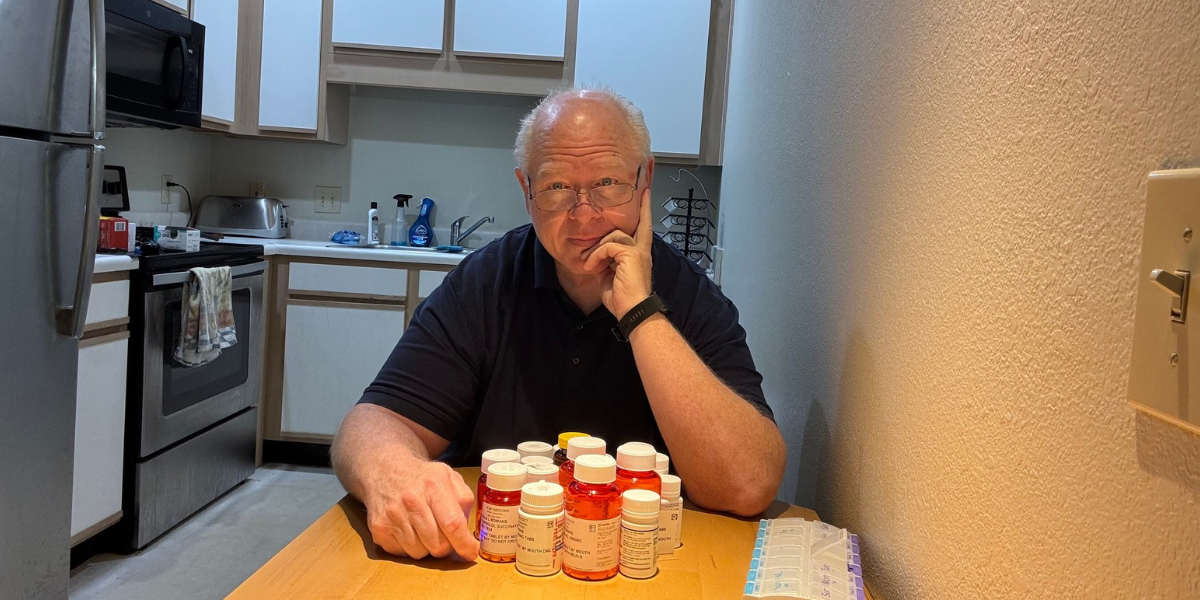
I did something recently that I probably shouldn’t have done.
At 66 years old, I started taking myself off some of my prescription medications without asking my doctor.
Not because I couldn’t afford them. Not because I was having terrible side effects. And not because a doctor had recommended stopping them.
I simply started questioning whether I needed all those medications in the first place.
I had been reading about blood pressure targets, diabetes treatment guidelines, and the possibility that some older adults might be taking more medications than necessary.
And somewhere along the way, I convinced myself that maybe I was one of those people.
Initially, things seemed to be going pretty well.
Then my blood pressure spiked, I developed a severe headache, and I started wondering whether I’d made a serious mistake.
Eventually, I scheduled an appointment with a geriatrician to get a second opinion.
What happened next wasn’t exactly what I expected.
Important: This article describes my personal experience, not medical advice. Stopping or changing prescription medications without medical supervision can be dangerous. I’m sharing what I did, including the mistakes I made, not suggesting anyone follow my example.
Why I Started Questioning My Prescription Medications at 66
I’m 66 years old, overweight, and dealing with type 2 diabetes and high blood pressure.
I walk every day and try to stay active, but like many people my age, I’ve accumulated quite a collection of prescription medications over the years.
At the beginning of this experiment, I was taking ten medications related to diabetes, blood pressure, cholesterol, triglycerides, and cardiovascular health.
And I started asking myself a question:
Do I really need all of these?
Part of what motivated me was my growing skepticism about pharmaceutical companies and their influence on medical treatment.
I believe the pharmaceutical industry has too much influence over healthcare guidelines and treatment standards.
That’s my opinion. I realize other people may see things differently.
But the more immediate issue was personal. I wanted to know whether the medications I was taking were still necessary for someone my age.
I’ve discovered that retirement brings plenty of decisions that seemed simpler when I was younger. In my article about retirement mistakes being more expensive than you think, I explored how some decisions become harder to recover from later in life.
As it turned out, my medication experiment was another example of why that matters.
Blood Pressure and A1C Targets Got Me Thinking
My regular doctor has generally wanted my blood pressure around 120/80.
But during my research, I came across information suggesting that some older adults may have less aggressive blood pressure targets, sometimes around 140/90.
I also read about different A1C goals for people with diabetes.
An A1C below 5.7% is considered within the normal range for someone without diabetes. But for people who already have diabetes, treatment targets are individualized.
Some older adults may have A1C goals of 7% or 7.5%, or even higher depending on their health and circumstances.
So I started wondering whether my doctors were trying to get my numbers lower than they really needed to be.
And whether I was taking extra medications to accomplish that.
Here’s what I didn’t fully appreciate at the time: A treatment target that’s appropriate for one older adult isn’t necessarily appropriate for another.
Age matters, but so do medical history, cardiovascular risk, other conditions, and individual circumstances.
I was reading general information and applying it to myself.
That was a pretty significant assumption.
The Five Medications I Stopped Taking
My original medication list included ten prescriptions and preventive medications.
For diabetes, I was taking Metformin, Farxiga, and Ozempic.
For blood pressure, I was taking Irbesartan, Metoprolol, Amlodipine, and Hydralazine.
I was also taking Rosuvastatin, Fenofibrate, and low-dose aspirin.
Over time, I independently stopped taking five of them:
- Metformin
- Hydralazine
- Fenofibrate
- Rosuvastatin
- Low-dose aspirin
I also reduced my Amlodipine and eventually tried stopping it completely.
I continued taking Irbesartan, Metoprolol, Farxiga, and Ozempic.
These changes weren’t made all at once, but they were made without a doctor supervising the process.
I was using ChatGPT and Google AI to research the medications, treatment targets, and possible consequences.
And I want to emphasize something.
Both repeatedly warned me not to change my medications without consulting my doctor.
I didn’t misunderstand those warnings.
I simply chose to proceed anyway.
Looking back, that wasn’t a good decision.
I Started Tracking My Blood Pressure and Blood Sugar
I wasn’t making these changes without paying attention to what happened afterward.
Every morning, I checked my fasting blood sugar.
I also checked my blood pressure three times a day: morning, afternoon, and evening.
I recorded the readings in a spreadsheet so I could monitor trends instead of relying on individual numbers.
At first, the results were encouraging.
My fasting blood sugar remained fairly stable, and my blood pressure seemed reasonably controlled.
I started thinking that maybe my suspicions had been correct.
But there’s an important distinction between monitoring your numbers and knowing whether your medication plan is safe.
Home readings can provide useful information, but they don’t tell you everything a medication may be doing, including its longer-term protective benefits.
And then I experienced something that made me question the entire experiment.
My Blood Pressure Spiked After I Stopped Amlodipine
At one point, I’d stopped taking Amlodipine entirely.
Then one day, I ate some pretty unhealthy, high-sodium fast food.
Shortly afterward, my weight jumped by approximately eight pounds.
My blood pressure also started climbing.
The bottom number, or diastolic pressure, moved into the 90s and eventually reached 100.
I developed a severe headache.
Now, the weight eventually came back down, which made me suspect that much of the sudden increase had been water retention related to the sodium.
But I can’t say with certainty what caused the blood pressure spike.
Was it the high-sodium food?
Was it stopping Amlodipine?
Was it a combination of the two?
I don’t know.
What I do know is that the experience got my attention.
I restarted Amlodipine at 5 milligrams, and my blood pressure readings eventually improved.
Before my appointment with the geriatrician, my seven-day averages were approximately:
| Measurement | Seven-day average |
|---|---|
| Blood pressure | 130/84 |
| Fasting blood sugar | 115 mg/dL |
Those numbers looked reasonably good to me.
But I was beginning to understand that good numbers alone didn’t necessarily mean I’d made the right medication decisions.
Why I Decided to See a Geriatrician
During my research, Google AI suggested that I consider seeing a geriatrician.
A geriatrician is a physician who specializes in caring for older adults. Part of that work can involve reviewing medications, evaluating treatment goals, and considering whether a patient’s prescriptions are still appropriate.
That sounded exactly like what I needed.
I like my regular primary care doctor, but I was concerned he might not agree with my thinking about higher blood pressure and A1C targets.
I was also uncomfortable admitting that I’d already stopped several medications.
To be fair, those concerns were my assumptions. My primary care doctor hadn’t actually told me he wouldn’t consider a medication review.
Still, I wanted another perspective.
So I scheduled an appointment at the University of Louisville Physicians Optimal Aging Clinic.
I went in with one central question:
Was I being overmedicated, or was I misunderstanding what those medications were doing for me?
And I was prepared to follow the geriatrician’s recommendations, even if that meant restarting everything.
This experience also reminded me of another issue I’ve written about: what happens when you get sick and live alone in retirement.
When you’re accustomed to managing everything independently, it’s easy to believe you can handle every problem yourself.
But independence doesn’t eliminate the need for professional help.
What Happened at My Geriatrician Appointment?
The appointment took approximately two and a half hours.
There was some waiting, an evaluation by a young cardiology intern, and even a brief memory screening.
But the most valuable part was the time I spent with the geriatrician herself.
She spent about an hour discussing my medications, blood pressure, diabetes, and concerns about treatment guidelines.
She listened carefully and answered my questions.
And I appreciated that, particularly because I was prepared to hear things I might not agree with.
As it turned out, that’s exactly what happened.
The Geriatrician Disagreed With My Blood Pressure Target
One of my biggest arguments was that, at 66, perhaps I didn’t need to maintain blood pressure around 120/80.
Maybe 140/90 was good enough.
The geriatrician disagreed.
She explained that more relaxed targets may be appropriate for certain considerably older or medically complex patients, but she didn’t believe that approach was appropriate for me.
She still wanted my blood pressure around 120/80.
And my reading in her office?
142/94.
That certainly didn’t strengthen my argument.
She recommended increasing Amlodipine back to 10 milligrams daily.
However, she also agreed that I could remain off Hydralazine.
So even though she disagreed with my preferred blood pressure target, she didn’t insist that I restart every medication I’d stopped.
That was encouraging.
My A1C Result Was 6.5%
We also discussed diabetes.
I’d been hoping that an A1C target of 7% or 7.5% might be appropriate for me.
But she explained that those more relaxed targets weren’t necessarily suitable for my circumstances.
She suggested an individualized goal around 6.6%.
She ordered bloodwork to see where my A1C stood before making a final decision about Metformin.
The result came back at 6.5%.
And afterward, she confirmed that Metformin could remain discontinued.
That was good news.
But there’s an important qualification.
I’m still taking Farxiga and Ozempic.
So this doesn’t mean my diabetes has disappeared or that I no longer need treatment.
It means that, based on my results and her assessment, Metformin was no longer part of my prescribed treatment plan.
Which Medications Did the Geriatrician Discontinue?
This was probably the most satisfying part of the appointment.
After reviewing my situation, the geriatrician agreed that three medications could remain discontinued.
| Medication | Final decision |
|---|---|
| Metformin | Discontinued |
| Hydralazine | Discontinued |
| Fenofibrate | Discontinued |
| Rosuvastatin | Replaced with Pravastatin |
| Amlodipine | Increased to 10 mg daily |
| Low-dose aspirin | Restarted |
| Irbesartan | Continued |
| Metoprolol | Continued |
| Farxiga | Continued |
| Ozempic | Continued |
She wanted me to continue taking a statin, but switched me from Rosuvastatin to Pravastatin, which she described as a milder option.
She also recommended restarting low-dose aspirin for stroke prevention as part of my individual treatment plan.
Aspirin isn’t appropriate for everyone, particularly because of bleeding risks, so that recommendation should not be interpreted as general advice for older adults.
The final result?
I went from ten medications in this group to seven.
Three were discontinued, and one statin was replaced by another.
That’s not the outcome I originally expected, but I was pleased with it.
More importantly, those decisions were now being made with a physician rather than through my own experimentation.
What About My Regular Doctor?
One concern I had before the appointment was whether I’d need to switch primary care doctors.
I didn’t want to.
My regular doctor is conveniently located, I like him, and getting to his office is easy.
The geriatrician’s office is downtown, which isn’t nearly as convenient.
Fortunately, they’re part of the same medical group and share my medical records.
That means my primary care doctor can see the geriatrician’s recommendations and the medication changes.
I can continue seeing him and return to the geriatrician occasionally when I want another opinion.
That’s a good arrangement.
Healthcare decisions also affect our retirement finances and insurance choices. I recently went through a similar process of questioning my assumptions when deciding whether to keep Medicare Advantage or switch coverage for 2027.
In both situations, I learned that what sounds convincing in a video or article isn’t necessarily the right answer for my personal circumstances.
Was I Foolish or Was I Right to Question My Medications?
That’s the question I keep coming back to.
Was it foolish to stop taking prescription medications without asking my doctor?
Yes, I believe it was.
I took risks I didn’t need to take, and the blood pressure spike was a reminder that changing medications can have consequences.
But was I wrong to question whether I still needed every medication?
I don’t think so.
The medication review resulted in three medications being discontinued and another being changed.
The distinction is important.
Questioning a treatment plan is not the same thing as independently changing it.
I could have asked for a comprehensive medication review without stopping anything first.
And that’s what I should have done.
The geriatrician didn’t agree with my original theory about blood pressure and A1C targets.
I was hoping she would.
But I was satisfied with her answers even though she didn’t.
I wasn’t there just to find someone who would tell me I was right.
I wanted to understand what was right for me.
Should Older Adults Ask for Medication Reviews?
One lesson I’ve taken from this experience is that a medication review is worth discussing with your healthcare professional, especially when you’ve accumulated multiple prescriptions over the years.
A useful conversation might include questions such as:
- What is each medication treating or preventing?
- Do I still need it based on my current health?
- Are there side effects or interactions worth discussing?
- Are my blood pressure and A1C goals appropriate for me?
- Would a pharmacist-led medication review or specialist consultation be helpful?
- If a medication might be discontinued, how should that be supervised and monitored?
The answers won’t be the same for everyone.
Some people may discover that their current medications are all necessary.
Others may find that changes are appropriate.
And some medications have benefits that aren’t obvious from a home blood pressure monitor or a blood sugar reading.
As I’ve written in what I would do differently if I could start retirement over, protecting our health and independence becomes increasingly important as we age.
That includes being willing to ask questions—and knowing when to get help.
My Biggest Lesson From Stopping Prescription Medications
Looking back, I’m glad I questioned my medications.
I’m glad I researched the treatment goals.
And I’m especially glad I made the appointment with the geriatrician.
But I wish I’d done those things before taking myself off five medications.
I ended up with fewer prescriptions and a treatment plan I understand better.
That’s a positive outcome.
But it doesn’t mean the way I got there was safe or advisable.
Getting older doesn’t automatically mean we should be taking fewer medications.
And it doesn’t mean we should continue every medication indefinitely without occasionally reviewing whether it’s still necessary.
For me, the answer was somewhere in the middle.
I needed some of the medications I’d questioned.
I didn’t need others.
And I needed a physician to help determine the difference.
Have you ever asked your doctor to review all your prescription medications? Did anything change?
I’d be interested in hearing about your experience in the comments.
Because sometimes the most useful thing we can do as we get older isn’t assume we know the answer.
It’s ask a better question.
About the author: Don Romans is the creator of Retired and Trying, where he shares personal experiences, retirement decisions, simple living, and the occasional lesson learned the hard way. His articles reflect his own experiences and are not a substitute for professional medical advice.
