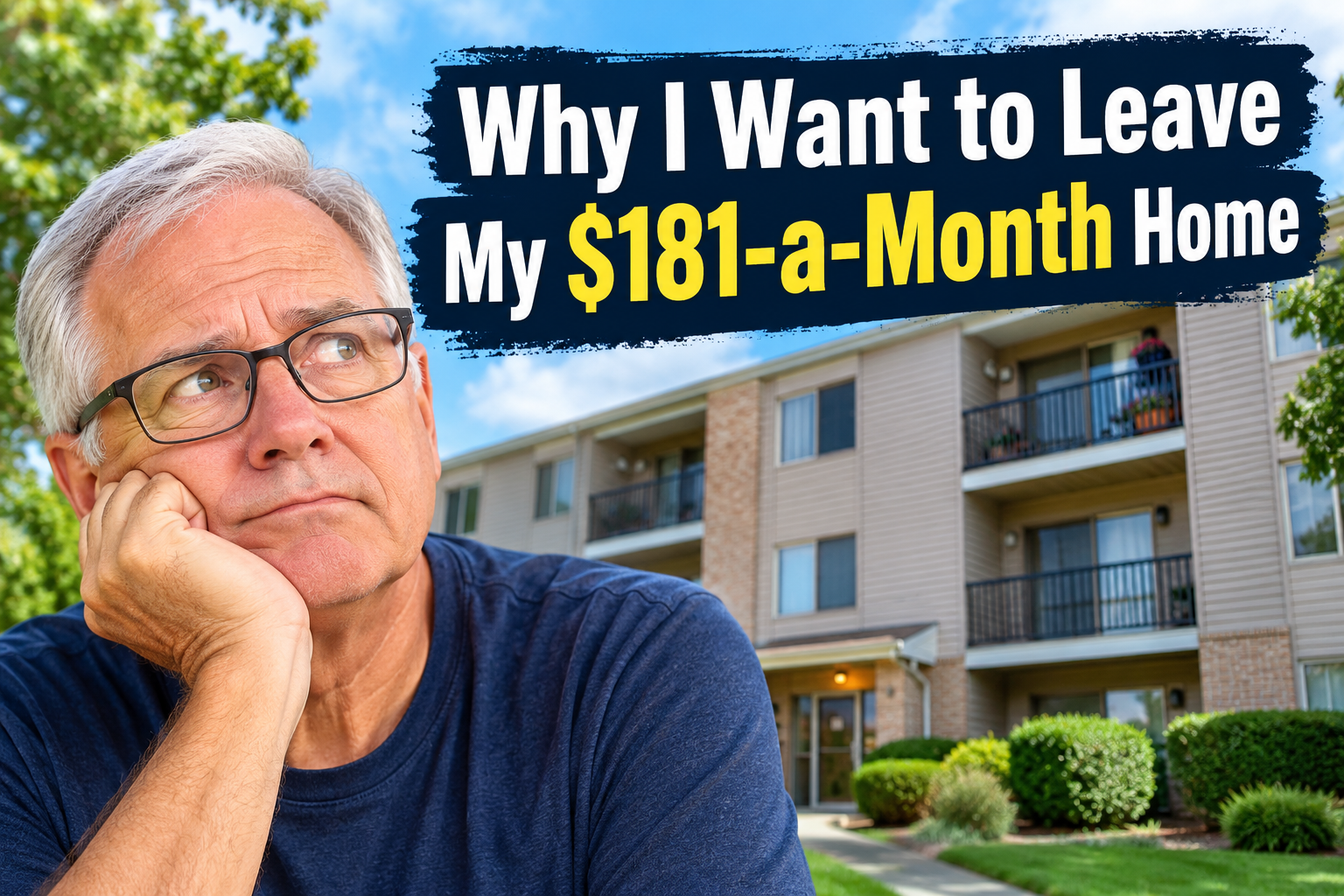
My total housing cost is only $181 a month.
My condo is paid for. I pay $125 a month in maintenance fees, about $35 for insurance, and roughly $21 a month in property taxes.
In today’s housing market, that sounds almost impossible to give up.
And yet there are days when I would love to move.
The reason isn’t the condo itself. It’s one of the biggest tradeoffs of apartment and condo living: you have very little control over the people living around you.
I’ve lived here for many years, and I’ve had quiet neighbors, noisy neighbors, barking dogs, screaming children, late-night gatherings, cigarette smoke, and even a chair thrown from a third-floor balcony.
Most of the time, though, you could hear a pin drop.
That’s what makes the decision so complicated.
My $181 Monthly Housing Cost
Let’s start with the number that makes moving so difficult.
My monthly housing expenses are approximately:
- Maintenance fee: $125
- Condo insurance: $35
- Property taxes: $21
- Total: $181 per month
There are utilities and normal living expenses beyond that, of course, but the basic cost of keeping a roof over my head is extraordinarily low.
That has been a huge advantage in retirement. Keeping housing costs low can make a tremendous difference when you’re trying to make a fixed retirement income stretch.
But there’s another side to inexpensive housing.
Sometimes the financially smart place to live isn’t necessarily the place you’d choose if money weren’t part of the equation.
Condo Living Is Really Shared-Building Living
My building has 24 units. It’s essentially divided into two sections, so the 12 units on my end are the ones that affect my daily life.
I’m on the second floor and on a corner.
That means I have someone above me, someone below me, and one neighbor sharing a wall beside me.
My next-door neighbor is another retiree. She’s quiet, and I almost never hear anything from her.
In fact, most of the people around me are quiet.
That’s important because I don’t want to give the impression that I live in constant chaos.
I don’t.
The problem is that it only takes one noisy neighbor to change what it’s like to live in your own home.
That’s one of the things people don’t necessarily consider when they’re thinking about downsizing in retirement and the things nobody warns you about.
One Bad Neighbor Can Change Everything
The family below me is currently the biggest problem.
Sometimes I can simply hear them talking or laughing. That’s part of living around other people, and I understand that.
Other times it’s different.
There have been screaming arguments early in the morning. The adults yell. The kids yell. Profanity starts flying.
And then suddenly everything stops.
An hour later, the building might be completely silent again.
The person above me is different. I hear him walking. I hear cabinets closing. Sometimes I can even hear his bed creaking when he gets into it.
It can almost feel like we’re sleeping in bunk beds.
But I don’t really fault him for that. He has to walk around his home.
I’ve also been the upstairs neighbor making noise.
Years ago, my granddaughter was visiting and playing with a toy that had a little hammer. The man below me eventually came upstairs and asked if we could stop the hammering.
He had a point.
There is a difference between normal living noise and being inconsiderate of the people around you.
I’ve Tried Some Unusual Solutions
I’ve had neighbors above me with dogs that sounded like a herd of animals running across the ceiling.
They also barked.
At one point, I found a supposed dog-whistle sound on YouTube. It was a frequency dogs were supposedly able to hear even though I couldn’t.
I turned the television all the way up and played it.
It didn’t work.
My solution for loud music has been slightly more entertaining.
I found an air-horn sound on YouTube.
If the music downstairs gets ridiculously loud, I’ll turn my television up, play the air horn for a few seconds, and turn it back off.
It’s basically my way of saying:
I can hear you up here.
I’m not recommending this as an official noisy-neighbor strategy.
I’m just telling you what I’ve done.
The Neighbors Can Change Overnight
One of the strangest things about living in a building like this is how quickly the atmosphere can change.
At one point, people across from me would drag a barbecue grill outside at two or three in the morning.
There might be 10 or 12 people standing outside talking, laughing, and grilling—right outside my bedroom window.
Another nearby apartment had frequent screaming and fighting.
Eventually those people moved.
Today?
Both apartments are quiet.
That’s the gamble with apartment or condo living.
You finally get rid of a bad neighbor, celebrate for about five minutes, and then realize:
You’re just rolling the dice again.
You have no idea who is moving in next.
That’s an important consideration when deciding whether a smaller home or condo is really the right retirement housing option for you.
You can inspect the home you’re buying or renting.
You can’t inspect every future neighbor you’re going to have.
Then Someone Threw a Chair Off the Balcony
Probably the craziest period happened after another condo owner moved away.
She was retired and very nice, but she didn’t particularly like living here either. Eventually an investor bought her condo and rented it out.
For a while, there would sometimes be 10 or 12 teenagers gathered outside the building at night.
One evening I had to walk through the group to get home.
I kept it friendly and said, Apparently this is the place to be.
They laughed, and I went inside.
There was no problem.
But there were also frequent arguments and screaming associated with that unit.
Then one day I watched someone throw a chair from the third-floor balcony.
It landed on my next-door neighbor’s car.
Eventually those tenants were gone, and the condo sat empty for quite a while.
Once again, the problem disappeared when the people disappeared.
What About Complaining to Management?
Whenever people talk about noisy neighbors, one of the first suggestions is usually to talk to the neighbor or complain to management.
I’ve done both.
I’ve confronted neighbors in the past. I’ve gone to management numerous times. I’ve even brought audio and video recordings so they could hear or see what was happening.
When situations became serious enough with fighting and screaming, I’ve called the police.
Management has generally been polite.
The response is usually some version of:
Thanks for telling us. We’ll address it.
From my perspective, very little changes.
I’m also much less interested these days in confronting a stranger at their door.
You don’t always know how someone will react, and sometimes an argument over noise simply isn’t worth escalating.
Noise Isn’t the Only Problem With Shared Living
One thing I’ve learned is that your neighbors can affect your home without making a sound.
Cigarette smoke is a good example.
I’ve never smoked, and I’m very sensitive to cigarette smoke. This property is supposedly smoke-free, including the grounds.
Yet people smoke here.
Sometimes I’ll be sitting inside my condo and suddenly smell cigarette smoke.
I don’t even know exactly how it’s getting inside. Our ductwork isn’t shared.
But somehow it makes its way into my home.
Then there are the dogs.
A number of people in the building have dogs, and many of them bring their dogs to the grassy area outside my condo.
They’re supposed to clean up after them.
That doesn’t always happen.
Occasionally I’ve even found dog waste on the sidewalk while walking to my car.
These might sound like little things individually.
After you’ve lived somewhere for years, however, they add up.
What You Give Up When You Downsize
I still believe downsizing can make a lot of financial sense.
A smaller home can mean lower expenses, less maintenance, and fewer things to take care of.
But there are tradeoffs.
If you’re moving from a detached house into an apartment or condo, one of those tradeoffs may be control over your environment.
You don’t choose who lives above you.
You don’t choose who lives below you.
You don’t choose who moves in next door six months from now.
And having rules doesn’t necessarily mean those rules will always be followed or enforced.
That’s one reason I think housing deserves much more thought than simply asking what you can afford. Some retirement mistakes can be more expensive than we realize, particularly when they involve decisions that are difficult or expensive to reverse.
Why I Still Think a House Is Better
If money weren’t part of the equation, I would rather live in a detached house.
That doesn’t mean houses guarantee good neighbors.
You can still have barking dogs next door. Someone can play loud music. You can have neighbors you don’t particularly like.
But there’s one thing a house usually gives you that an apartment or condo doesn’t:
Distance.
Nobody is walking across your ceiling.
Nobody lives underneath your floor.
Nobody shares the wall on the other side of your bedroom.
After living both ways, that separation has real value to me.
It’s one of those things I probably didn’t fully appreciate until I didn’t have it anymore.
So Why Don’t I Just Move?
This is where we come back to $181.
My condo is paid for.
My total monthly housing cost is about $181.
Where am I going to replace that?
I could sell the condo and rent somewhere else, but I’d be exchanging an extraordinarily low housing expense for a much larger monthly payment.
And rent can go up.
Worse, I could spend considerably more money every month and still end up with a noisy neighbor.
I could sell and try to buy another home, but what I could get for this condo isn’t going to buy me a comparable paid-off detached house somewhere I’d want to live.
I’ve looked at my retirement housing options when money is tight, and that’s ultimately the problem I keep coming back to.
My current situation is incredibly difficult to replace.
Sometimes having an inexpensive place to live can make you feel almost trapped by how good the numbers are.
My housing is so affordable that I almost can’t afford to move.
My Retirement Housing Wish
If I had a genie that could grant me one housing wish, mine would be easy.
I’d want a paid-off house.
It wouldn’t need to be big.
It wouldn’t need to be fancy.
I’d just want a little house where nobody lives above me, nobody lives below me, and nobody shares a wall with me.
But I don’t have a genie.
I have a paid-off condo that costs me $181 a month.
And as much as some of the things about living here can drive me crazy, that’s incredibly difficult to walk away from.
For now, that’s the tradeoff I’ve chosen to make.
It’s also one of those lessons that fits with the things every retiree eventually learns: the best financial decision and the perfect lifestyle decision aren’t always the same decision.
If you’re considering downsizing to an apartment or condo in retirement, don’t just look at the monthly payment, maintenance, amenities, and square footage.
Think about what it will be like to share your living environment with other people too.
Sometimes the things you can’t put on a spreadsheet matter just as much as the things you can.
Would you stay if your total housing cost were only $181 a month, or would the lack of control over your neighbors eventually make you move?

Leave a Reply