There are a lot of videos online about how much money YouTube pays.
I know because lately I seem to be seeing them everywhere.
“How Much YouTube Paid Me in Six Months.”
“How Much I Made With 10,000 Subscribers.”
“My YouTube Income Revealed.”
So I decided to look at my own numbers.
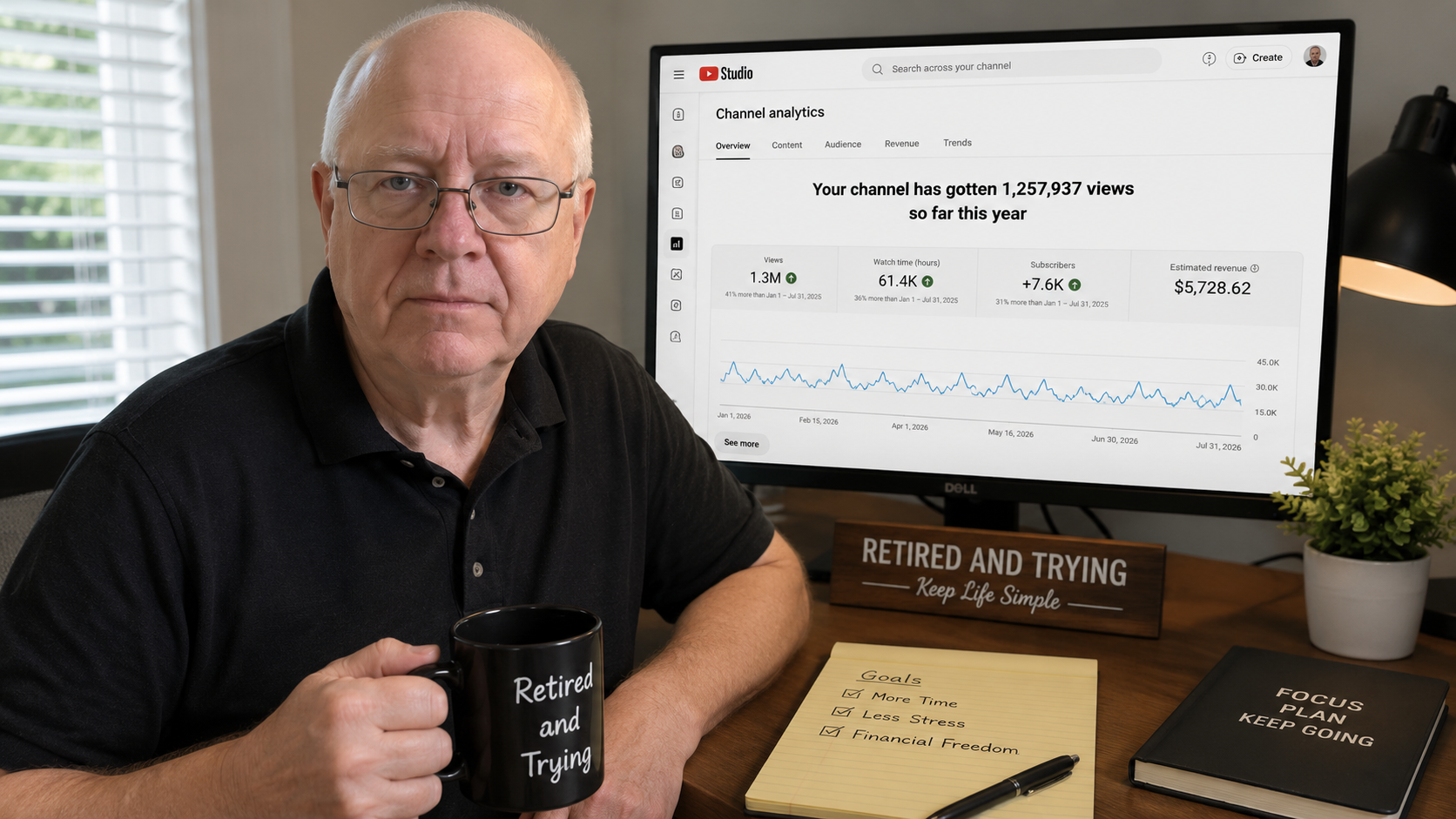
My YouTube channel has generated more than 1.2 million views in the first seven months of 2026, and YouTube shows estimated revenue of $5,728.62 through July 31.
Nearly $6,000.
That sounds pretty good for something I started after retirement.
But there’s another number that I think is considerably more important.
How much of that money actually changed my life?
The answer surprised me.
YouTube Says I Made $5,728.62
From January 1 through July 31, 2026, Retired and Trying received:
- 1,257,937 views
- 61,400 hours of watch time
- About 7,600 new subscribers
- $5,728.62 in estimated YouTube revenue
When I look at those numbers, even I’m impressed.
I certainly didn’t expect this when I started making videos.
But there’s a danger in looking at a number like $5,728 and thinking that’s the same thing as having an extra $5,728 available to spend.
It isn’t.
And that’s something I don’t think gets talked about enough in all of these “how much YouTube paid me” videos.
The Number on YouTube Isn’t the Number I Keep
Running Retired and Trying costs money.
I’ve bought equipment.
I pay for software and tools.
I’ve spent money advertising and promoting things I’m trying.
There are costs associated with the products and other experiments I’ve done along the way.
Through July, my records show $1,612.10 in business expenses.
My total business income during that same period was $5,725.83, leaving a profit of $4,113.73 before taxes.
Then there are taxes.
I’ve set aside roughly 25% for those.
After expenses and taxes, I’m left with approximately $3,085.
Spread over seven months, that’s roughly:
$440 a month.
That’s the number that means something to me.
$440 a Month Is Both a Lot of Money and Not Much Money
This is where talking about money in retirement gets strange.
If someone offered me an extra $440 every month for doing nothing, I’d take it in a heartbeat.
It’s real money.
But $440 a month also isn’t enough to suddenly live a completely different life.
It isn’t enough for me to move somewhere I couldn’t otherwise afford.
It isn’t enough to stop thinking about larger purchases.
It isn’t enough to make travel suddenly free.
I’ve been talking about buying a new television for months.
I still haven’t bought it.
Could I buy one?
Of course.
That’s not the point.
If I spend $1,000 on a television, that’s more than two months of what I’ve actually been keeping from this business.
Suddenly that purchase looks different than it does when you’re staring at a YouTube screen that says you made nearly $6,000.
That’s one reason I’ve become increasingly interested in the question I explored in How Much Money Do You Really Need in Retirement?
Sometimes the answer isn’t as simple as the big number we put on a spreadsheet.
What Did YouTube Actually Do for My Retirement?
This is the part I didn’t expect.
YouTube hasn’t made me rich.
It hasn’t completely changed my lifestyle.
But recently I realized it has changed the way I feel about money.
I don’t wait for my Social Security check anymore.
That’s a bigger deal than it probably sounds.
I’m not saying I was sitting here with an empty refrigerator counting the hours until Social Security showed up.
I wasn’t.
It’s more subtle than that.
When most of your retirement income arrives on a particular schedule, you become aware of that schedule.
The money comes in.
You pay what needs to be paid.
The month goes along.
And eventually you start thinking about when that next check arrives.
I used to do that.
Now I sometimes don’t even realize Social Security day is approaching.
The money arrives and I think, Oh yeah. Today’s the day.
YouTube did that.
An Extra $440 Bought Me Breathing Room
That’s probably the best description I can give you.
Breathing room.
YouTube hasn’t bought me a different life.
It has given me a little more room inside the life I already have.
And I think that’s something worth talking about, especially for retirees.
I wrote previously about 10 Choices That Let Me Live on Social Security, because Social Security remains an important part of how I support myself in retirement.
The YouTube money hasn’t replaced it.
Not even close.
What it has done is put another stream of money beside it.
And apparently an additional $400 or $500 a month was enough to change something psychologically.
I don’t feel quite as dependent on that next deposit.
WATCH THE VIDEO
In the video, I show the actual YouTube analytics and talk through what this money has—and hasn’t—changed about my retirement.
Maybe We Underestimate What a Few Hundred Dollars Can Do
We talk about retirement using enormous numbers.
You need $1 million.
You need $2 million.
You need 80% of your pre-retirement income.
You need enough to last until you’re 90.
Those are important conversations.
But they can also make an extra $300 or $400 a month sound almost meaningless.
I’m discovering that it isn’t.
An extra $400 might not buy you a house.
It probably won’t buy you a car.
It isn’t going to fund some lavish retirement.
But maybe you don’t think twice about the electric bill being $50 higher this month.
Maybe you go out to dinner occasionally without worrying about it.
Maybe an unexpected expense doesn’t immediately wreck the month’s budget.
Or maybe, like me, you simply stop looking at the calendar waiting for the next check.
That has value.
It’s one of the reasons my thinking about side income has changed since I wrote My Side Hustle Plan to Make $1,000 a Month in Retirement.
A thousand dollars a month still sounds wonderful.
But I’ve learned that you don’t necessarily have to reach $1,000 before the effort starts making a difference.
I Actually Did Reach $1,000 in a Month
There’s another interesting wrinkle to this story.
My income hasn’t been exactly $440 every month.
Some months have been considerably better than others.
I’ve already written about How I Hit $1,000 a Month in Retirement, and as Retired and Trying has grown, other opportunities have started appearing alongside YouTube advertising revenue.
That’s important because I don’t think YouTube AdSense by itself is necessarily the end goal.
A channel can lead to other things.
Affiliate income.
Sponsorships.
Products.
Memberships.
Or opportunities I haven’t even thought of yet.
Whether any of those become significant remains to be seen.
That’s why this is still called Retired and Trying.
But There’s a Cost That Doesn’t Show Up on My Spreadsheet
There’s one expense I haven’t deducted from that $440.
My time.
YouTube takes a lot of it.
I have to decide what to talk about.
Record the video.
Edit it.
Make a thumbnail.
Write the description.
Answer comments.
Look at analytics.
And then start thinking about the next video.
If I calculated my hourly wage based on every hour I’ve put into this channel, I’m not sure I’d want to know the answer.
That’s one reason I think The 7 Surprising Ways a Side Hustle Makes Retirement Better (Even When It Makes No Money) is still relevant.
The value of doing something after retirement isn’t necessarily limited to the money it produces.
I’ve gotten something to build.
I’ve met people through the channel.
I’ve learned things I never expected to learn at this age.
And I’ve had opportunities that wouldn’t have existed if I hadn’t started.
That doesn’t mean I’ll do it forever.
It does mean the return on this experiment can’t be measured entirely in dollars.
Would I Recommend Starting YouTube in Retirement?
If the only reason is to make money quickly?
Probably not.
It took time before this channel made meaningful money, and there was never a guarantee that it would.
There still isn’t.
YouTube could stop recommending my videos tomorrow.
People could stop watching.
The income could drop.
That’s very different from Social Security showing up every month.
But if you have something you want to talk about, something you want to build, or simply want a project that might eventually produce some extra income, I think it’s worth considering.
I talked about some of that in Smart Side Hustles for Retirees: Earning Without Stress.
The “without stress” part has become increasingly important to me.
I retired for a reason.
I don’t want to accidentally build myself another full-time job.
So, How Much Did YouTube Really Pay Me?
That’s actually harder to answer than I expected.
YouTube says it generated $5,728.62 through July.
After business expenses and estimated taxes, the amount I’ve actually been able to keep from the business works out to roughly $440 a month so far.
That hasn’t transformed my retirement.
I’m not suddenly wealthy.
I haven’t moved.
I’m not traveling the world.
I still haven’t bought that television.
But I don’t wait for my Social Security check anymore.
And maybe that’s the lesson I’m taking away from all of this.
We spend a lot of time asking how much money we need to completely change our lives.
Maybe there’s another question worth asking:
How much would it take to make the life you already have just a little easier?
For me, apparently, it was less than I thought.
And that may be the most valuable thing YouTube has paid me so far.
