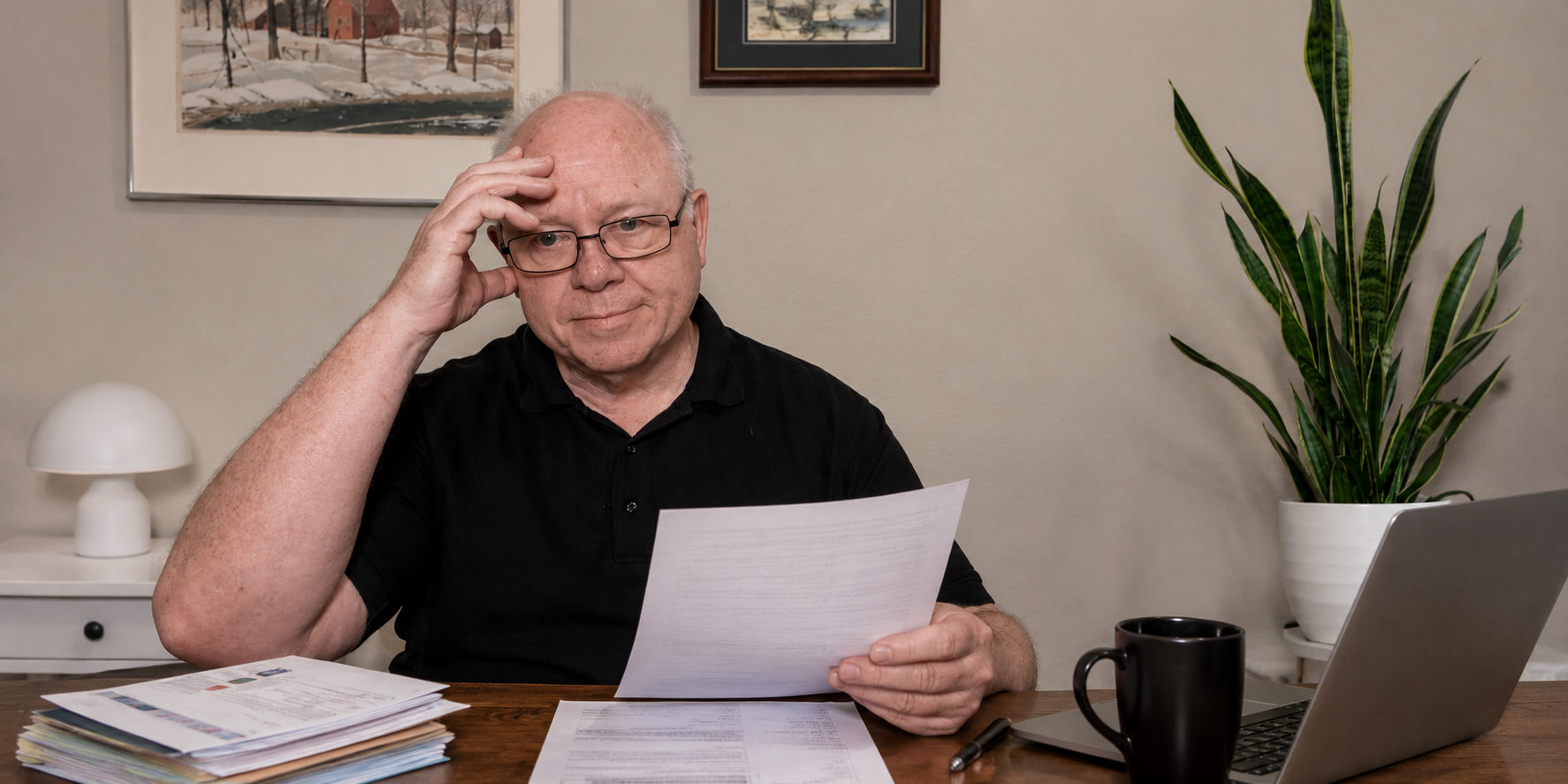
A few weeks ago, I opened my mailbox and found a bill from my podiatrist for $79.83.
Nothing unusual there.
At least that’s what I thought.
Like most people, my first reaction was simple: I guess I owe it.
The statement looked official. It had a balance due, a payment address, and all the usual language encouraging prompt payment. I was only a step away from writing a check when something stopped me.
🎥 Watch the full video here
Over the past year, I’ve spent more time dealing with doctors, specialists, tests, and insurance paperwork than I ever expected. Between a CT scan, an endoscopy, a colonoscopy, an ENT visit, and a handful of other appointments, I’ve learned that medical billing can be a lot more confusing than most retirees realize.
So instead of paying the bill, I decided to do one thing first.
I checked my Explanation of Benefits, commonly called an EOB.
What I found surprised me.
According to Anthem, I owed absolutely nothing.
Not a reduced amount.
Not part of the bill.
Zero.
That immediately raised a question.
If the doctor’s office said I owed $79.83 and my insurance company said I owed $0.00, who was right?
As it turns out, that simple question taught me a lesson every retiree should know before paying a medical bill.
Why Retirees Need to Pay Attention
When I was working, I probably wouldn’t have thought much about it. A bill arrived, I paid it, and moved on with my day.
Retirement changes your perspective.
It’s not necessarily that money is tight. It’s that you’re more aware of where it goes. Whether you’re living primarily on Social Security, drawing from retirement accounts, or receiving a pension, every dollar has a purpose.
That’s one reason I recently spent so much time thinking about whether to keep my life insurance policy in retirement. I wrote about that decision in Why I Almost Canceled My Life Insurance in Retirement, because retirement has a way of making you examine expenses differently than you did during your working years.
Medical bills deserve the same level of attention.
The problem is that healthcare billing has become incredibly complicated. A single doctor’s visit can generate paperwork from multiple sources. The provider sends a statement. The insurance company sends an EOB. Sometimes there are separate bills from facilities, labs, or imaging centers. They don’t always arrive in order, and they don’t always tell the same story.
That’s exactly what happened to me.
The Podiatrist Bill That Didn’t Match
The bill showed a balance of $79.83.
When I logged into Anthem and reviewed the claim, the EOB showed my responsibility as $0.00.
At first, I assumed I must be missing something. Surely the doctor’s office wouldn’t send a bill if I didn’t owe the money.
But after calling Anthem, the representative confirmed what I was seeing.
According to Anthem, I didn’t owe the charge.
The provider’s billing department eventually corrected the issue, but it made me wonder how many people simply pay bills like this without asking questions.
Honestly, I almost did.
If I hadn’t looked at the EOB, I probably would have mailed the payment and never thought about it again.
Then It Happened Again
What really caught my attention was that this wasn’t an isolated incident.
Earlier in the year, I visited an ENT specialist. At the appointment, I paid my normal specialist copay, which for me is $45.
That seemed to settle the matter.
Weeks later, another bill arrived in the mail.
Again, I found myself wondering if I somehow owed more than I had already paid.
And again, the EOB told a different story.
After reviewing the claim and making a few phone calls, it became clear that my responsibility had already been satisfied through the copay.
The balance was eventually corrected.
Two different providers.
Two different billing situations.
The same lesson.
Never assume the bill that arrives in your mailbox is automatically correct.
Understanding the Difference Between a Bill and an EOB
One thing I’ve learned is that many people don’t fully understand what an Explanation of Benefits actually is.
I know I didn’t.
An EOB is not a bill.
It’s a document from your insurance company explaining how a claim was processed. It shows what the provider charged, what the insurance company approved, what insurance paid, and what portion may be your responsibility.
That last part is the key.
When I receive a medical bill now, the first thing I do is compare it against the EOB.
If the numbers don’t match, I stop right there and start asking questions.
Sometimes the provider simply generated a statement before insurance finished processing the claim. Sometimes there’s a coding issue. Sometimes it’s a billing error.
Whatever the reason, I’ve learned not to reach for my checkbook until I understand what’s going on.
“Covered” Doesn’t Mean Free
Another lesson that surprised me involves the word “covered.”
I used to assume that if insurance said a service was covered, that meant I wouldn’t owe anything.
Not true.
A service can be covered and still leave you responsible for copays, deductibles, coinsurance, facility fees, or other costs.
I learned this while dealing with several medical procedures over the past year.
Like many retirees, I’ve had enough interactions with the healthcare system to know that the words used in insurance documents don’t always mean what we think they mean.
A colonoscopy might be covered.
That doesn’t automatically mean every related service is free.
An office visit might be covered.
That doesn’t mean there won’t be a copay.
Understanding that distinction can save a lot of frustration.
My Experience With Larger Medical Charges
The $79.83 podiatrist bill got my attention because it was easy to understand.
But the larger medical procedures were actually more confusing.
When I had a CT scan, an endoscopy, and a colonoscopy, I received paperwork showing amounts that looked enormous at first glance.
Some statements showed thousands of dollars in charges.
Others showed insurance adjustments.
Others showed amounts that appeared to be my responsibility.
Looking at any single document by itself would have given me the wrong impression.
Only after comparing everything together did the situation start making sense.
That’s why I tell people not to panic when they see large numbers on medical paperwork. The first number you see is rarely the whole story.
Why I Keep an Emergency Fund
One reason these situations don’t create panic for me is that I maintain an emergency fund.
I’ve written before about my emergency fund strategy because retirement has taught me that unexpected expenses never completely disappear. They simply change form.
When you’re working, an emergency might be a car repair or a furnace replacement.
In retirement, it could be a medical bill, a dental procedure, hearing aids, or something else you never saw coming.
Having cash set aside doesn’t solve billing problems, but it does reduce the stress that comes from dealing with them.
What I Do Before Paying Any Medical Bill
After everything I’ve been through recently, I’ve developed a simple routine.
First, I wait for the insurance company to process the claim.
Second, I review the EOB carefully.
Third, I compare the EOB to the provider’s bill.
If the numbers don’t make sense, I call and ask questions.
That process has already saved me money and prevented unnecessary payments.
More importantly, it has given me confidence that I’m only paying what I actually owe.
The Bigger Lesson
The real lesson here isn’t about insurance.
It’s about slowing down.
Most of us are conditioned to pay bills as soon as they arrive. We don’t want late fees, collection notices, or unnecessary headaches.
But medical billing is different.
There are too many moving parts, too many adjustments, and too many opportunities for mistakes.
The $79.83 bill from my podiatrist reminded me that asking questions isn’t being difficult. It’s being responsible.
Had I paid the bill immediately, I likely would have spent money I didn’t owe.
Instead, I took a few minutes to review the paperwork, make a phone call, and verify the facts.
That simple habit is something I’ll continue doing for every medical bill I receive.
And if you’re retired, it’s a habit I think is worth adopting too.
Before you pay that next medical bill, take a moment to check the EOB first.
You may discover the bill is correct.
But you may also discover it isn’t.
Either way, you’ll know for sure before your money leaves the bank account.
Have you ever received a medical bill that turned out to be wrong? I’d love to hear your experience in the comments.
