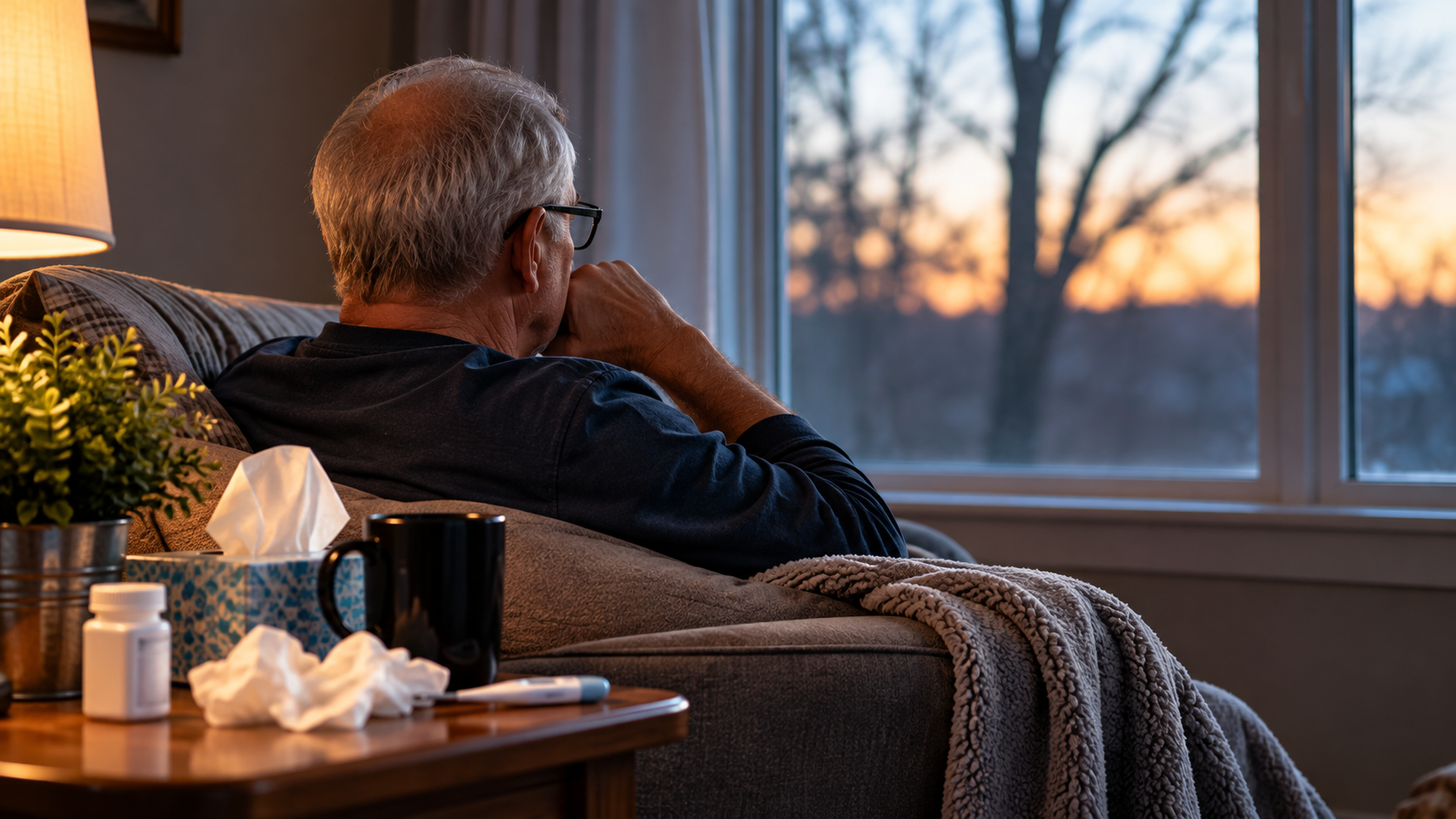
I’ve lived alone for 39 years.
I’m used to taking care of myself, and I actually enjoy the independence that comes with living alone. But recently I started thinking about something I’m not sure I’ve adequately planned for.
What happens if I get seriously sick while living alone in retirement?
I’m not talking about having a minor cold and spending a couple of days on the couch. I’m talking about an illness or emergency that temporarily leaves me unable to take care of myself.
Who knows I’m sick?
Who checks on me?
Who gets into my home if I can’t answer the door?
And perhaps the biggest question of all: At what point do I stop trying to handle everything myself and ask for help?
I’ve written before about the unexpected power of solitude when you live alone. I genuinely enjoy living alone. But enjoying solitude and being prepared for an emergency are two very different things.
Watch the Video
What Happens When You Get Sick and Live Alone in Retirement?
I’ve Been Taking Care of Myself for 39 Years
Fortunately, I haven’t had so much as a cold in years, and I’ve never had COVID.
That doesn’t mean I’ve never been sick.
I have gastroparesis, and there have been plenty of nights when I’ve woken up in the middle of the night throwing up.
When you live alone, there’s nobody in the next room who hears you.
Nobody brings you a glass of water.
Nobody asks if you need anything.
And nobody automatically asks the simplest question:
Are you okay?
I’m not looking for sympathy. I chose to live alone, I like living alone, and I’ve been doing it successfully for almost four decades.
But getting older has made me realize that being good at living independently doesn’t necessarily mean I’m prepared for every situation.
Getting Sick Alone Is Different
I always get a little irritated when I hear people joke about the “man flu.”
The joke is that men turn into babies when they get sick and need someone to take care of them.
That hasn’t exactly been my experience.
When you’ve lived alone for 39 years, you learn pretty quickly that if you’re sick, you still have to take care of yourself.
Need a glass of water? Get it.
Need something to eat? Make it.
Need medicine? Find it.
Wake up sick in the middle of the night? Deal with it.
For most ordinary illnesses, that works.
The question I’m starting to ask is what happens when it doesn’t.
Keeping Basic Medicine at Home Matters More When You Live Alone
One lesson I learned years ago was to keep some basic over-the-counter medicine and first-aid supplies in the house.
There were times in the past when I got sick and suddenly realized I didn’t have what I needed.
Maybe it was NyQuil, a pain reliever, something for a sore throat, Pepto-Bismol, or another basic item.
If you live with someone, that person can run to the drugstore.
When you live alone, guess who gets to go?
You do.
I can remember dragging myself to Walgreens while sick because I needed something and didn’t have it at home.
And illnesses have an annoying habit of showing up in the middle of the night.
If you discover at 2 a.m. that you need something you don’t have, your choices may be pretty limited. You either go out and get it yourself or wait until morning.
Today, I’m much better prepared.
My Medicare Advantage plan has included an over-the-counter benefit that allowed me to order certain products, so over time I’ve stocked up on basics such as cold medicine, pain relievers, stomach medicine, Band-Aids, and first-aid supplies.
It’s a small example of how being prepared can make living alone easier.
Delivery Services Have Made Living Alone Easier
One thing that has changed dramatically during the years I’ve lived alone is delivery.
Today I can have groceries delivered.
I can have many drugstore items delivered.
I can order food.
And transportation services such as Uber mean I don’t necessarily need someone available to drive me somewhere.
I don’t even ask someone to take me to the airport. I take an Uber.
If I need transportation somewhere and I’m physically capable of going by myself, I generally figure it out myself.
Technology and delivery services have made independent living much easier than it once was.
But they don’t solve everything.
Delivery can bring me NyQuil.
Uber can get me somewhere.
Neither one can look at me and ask:
Are you okay?
What If Nobody Knows You’re Sick?
This may be the part of living alone that concerns me more than getting groceries or medicine.
If I get sick tonight, nobody necessarily knows.
I could spend tomorrow in bed and nobody would find that particularly unusual because there are plenty of days when nobody sees me.
That’s normal when you live alone.
Someone who lives with a spouse or partner has another set of eyes in the house.
If they haven’t gotten out of bed all day, somebody notices.
If they haven’t eaten, somebody notices.
If they’re getting worse instead of better, somebody may recognize it.
That person can say, “Something isn’t right. I think you need to get some help.”
When you live alone, you may have to recognize that point yourself.
And what if you’re too sick to recognize it?
That’s where this becomes much more serious.
What Happens During a Serious Illness When You Live Alone?
A cold is one thing.
What happens if I have a stroke?
What if I fall?
What if I become seriously ill and confused?
What if I can’t reach my phone?
What if I’m physically capable of asking for help but I’m not thinking clearly enough to understand that I need it?
Those questions are one reason I’ve become more interested in simple home safety tools for retirees living alone. Staying independent isn’t only about being able to pay the bills or maintain the house. It also means thinking about what happens when something goes wrong.
After 39 years of living alone, my natural response to most problems is pretty simple:
I’ll handle it.
Most of the time, that attitude has served me well.
But I have to acknowledge that there could eventually be a situation where trying to handle everything myself is exactly the wrong thing to do.
Living Alone Doesn’t Mean Having No One
There’s an important distinction here.
Living alone doesn’t mean I have nobody.
I have my daughter.
When I’ve had knee replacements, she has been there.
When I’ve had colonoscopies or other procedures where the medical facility requires someone to accompany me home, she has been there.
Those situations are relatively easy to plan for because they’re scheduled.
I know when the procedure is happening. My daughter knows when it’s happening. We can make arrangements.
An unexpected serious illness is completely different.
It doesn’t make an appointment.
And that’s where I realized there’s a hole in my own retirement planning.
I Don’t Have an Emergency Plan for Living Alone
I wish I could follow all of this by giving you my perfect five-step emergency plan.
I can’t.
I don’t have one.
That’s actually one of the biggest things I’ve taken away from thinking about this subject.
I need to create one.
It doesn’t necessarily have to be complicated.
If I’m sick, perhaps I simply need to let my daughter know.
I’m not asking her to drop everything and come take care of me.
I could simply say:
I’m pretty sick today. I’m okay, but I’ll check in with you tomorrow.
Now somebody knows.
If the next day comes and she doesn’t hear from me, there’s a reason to check.
Other questions are worth considering too.
Does someone you trust have a way to get into your home?
Who would you call first in an emergency?
Does that person know where your important information is?
Those questions also made me think about something I’ve written about before: protecting and organizing your retirement paperwork and emergency information. Having the documents is important, but someone also has to know how to find them when you can’t explain where they are.
At what point do you stop trying to manage an illness yourself?
I don’t have all of those answers yet.
Downsizing Can Change More Than Your Housing Costs
Thinking about illness also made me look at another retirement topic differently: downsizing.
I’ve written quite a bit about what nobody warns you about when downsizing in retirement.
Usually we approach downsizing as a financial or lifestyle decision.
Could I reduce my housing expenses?
Would a smaller home be easier to maintain?
Could I move somewhere with a lower cost of living?
Would I rather live somewhere warmer?
Those are all reasonable questions.
But there’s another one:
Where are the people you may need someday?
Suppose you currently live relatively close to your children, family members, or longtime friends.
Then you retire and move 500 or 1,000 miles away.
When you’re healthy, that may not matter at all.
But if something serious happens, you’ve changed more than your address.
You’ve changed how quickly someone you trust can get to you.
Affordable Housing Isn’t the Only Consideration
I’ve spent a lot of time looking at retirement housing options when money is tight, and affordability absolutely matters.
For many retirees, housing is the biggest expense in the budget.
Moving somewhere cheaper can make the difference between struggling every month and having some breathing room.
But what did you leave behind to get that cheaper housing?
If your children, close friends, doctors, and support system are hundreds of miles away, that has value too—even if it never appears on a spreadsheet.
I saw another version of this when I looked at campground living as an affordable retirement option. Housing isn’t only about finding the lowest monthly cost. The lifestyle and community surrounding that housing matter too.
That becomes even more important if you live alone.
What If You Move Away From Family in Retirement?
I don’t believe retirees need to live next door to their children.
And I certainly don’t believe our adult children should have to organize their lives around taking care of us.
Families naturally change over time. I’ve even written about how I realized I was drifting apart from my family in retirement and decided I wanted to do something about it.
But distance becomes a practical consideration when we start talking about emergencies.
Moving away doesn’t necessarily mean giving up your independence or taking an unreasonable risk.
It may simply mean you need to intentionally build a support system wherever you go.
That might be a trusted neighbor.
It might be a close friend.
It could be someone you meet in a retirement community.
The important thing may be having at least one person nearby who would notice when something isn’t right.
That’s easy to overlook when choosing a retirement location based primarily on weather, housing costs, taxes, or lifestyle.
Retirement Planning Is About More Than Money
This entire subject is another reminder that retirement planning isn’t only about hitting a particular number.
I recently wrote about how much money you really need to retire, and my conclusion was that there isn’t one number that works for everybody.
The same thing applies here.
Two people could have exactly the same income and exactly the same amount of savings but have completely different support systems.
One might have children and longtime friends ten minutes away.
The other might live 1,000 miles from everyone they know.
Those are two very different retirements even if the financial numbers look identical.
It’s one more example of the retirement questions nobody warns you about.
Independence Doesn’t Mean Doing Everything Yourself
I have no intention of giving up living alone simply because I’m getting older.
I like my independence.
But perhaps I’ve been looking at independence a little too narrowly.
Being independent doesn’t necessarily mean never needing anyone.
It may mean having the systems in place that allow you to continue living independently even when something temporarily goes wrong.
That could include keeping basic medicine and supplies at home.
It could mean knowing how you’ll get food or transportation when you’re sick.
It could mean making sure someone knows when you’re not feeling well.
And it could mean having a plan for the much bigger problems we hope never happen.
I don’t have that entire plan figured out yet.
But I’ve realized I need to.
What’s Your Plan If You Get Sick While Living Alone?
This is one of those subjects where I think people who have already dealt with it can teach the rest of us a lot.
If you’re retired and live alone, what is your plan?
Does someone have a key to your home?
Do you tell someone when you’re sick?
Do you have a friend or neighbor who checks on you?
If your children or family live hundreds of miles away, have you built a local support system?
And has proximity to family influenced where you’ve chosen to live in retirement?
I’ve taken care of myself for 39 years, and I plan to remain as independent as possible for as long as possible.
But I’ve realized there’s a difference between being independent and being unprepared.
If something serious happened tonight, I don’t yet have the plan I think I should have.
That’s something I’m going to work on.
And if you live alone in retirement, it might be worth asking yourself the same question:
If something serious happened to you tonight, what’s your plan?

Leave a Reply